
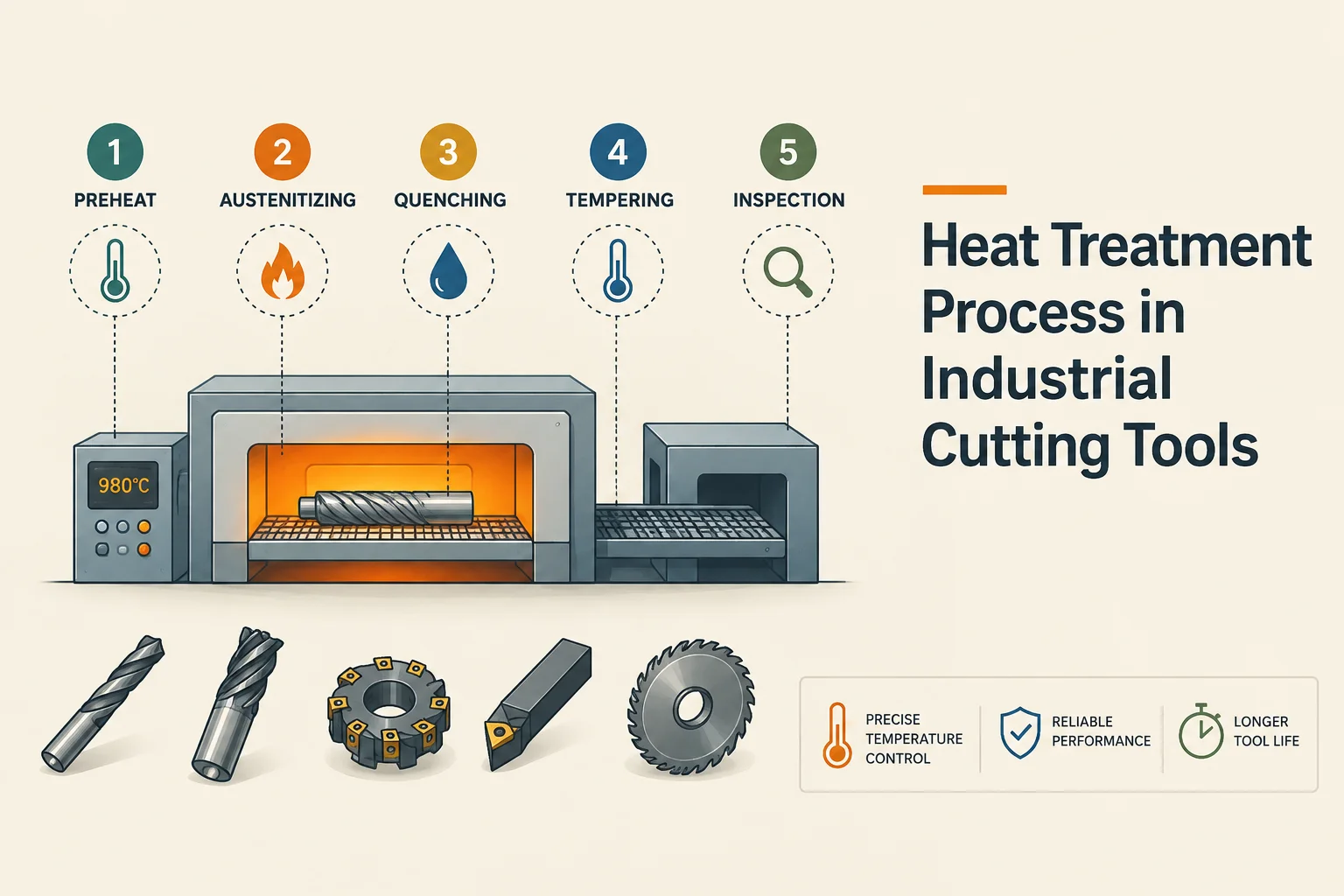
A cutting tool’s performance is decided long before it ever touches a workpiece. It is decided in the furnace. According to Total Materia’s engineering reference data, high-speed steel cutting tools retain significant hardness up to 500°C, a property known as hot hardness that lets them keep cutting at speeds and temperatures that would soften ordinary carbon steel. That single property is the reason the heat treatment process exists at all. As one of the leading manufacturers of heat-treated cutting tools, Maxwell Tools explains the heat treatment process and compares the high-speed steel grades for industrial tools that go through it.
What a Manufacturer of Heat-Treated Cutting Tools Actually Does
Heat treatment is not one step. It is a sequence, and skipping or rushing any stage changes the final result. Here are all the stages of heat treatment:
Preheating
Raw high-speed steel is heated slowly, in two or three stages, up to around 850–900°C before reaching full hardening temperature. High-speed steel is heavily alloyed with tungsten, molybdenum, chromium, and vanadium, so heating it too fast creates thermal gradients between surface and core, which cause distortion or cracking in complex shapes like gear hobs and broaches.
Austenitizing
The tool is brought up to its hardening temperature, typically 1150–1230°C depending on grade. Carbon and alloying elements dissolve into the steel’s crystal structure, forming austenite. This stage stays short and closely controlled, since holding the steel too long at peak temperature coarsens the grain structure and can partially melt the carbides that give the steel its wear resistance.
Quenching
The tool is cooled rapidly, in oil, salt bath, or pressurized gas, to transform austenite into martensite, the hard phase that gives cutting tools their edge-holding ability. The cooling rate must be fast enough to avoid softer transformation products but controlled enough not to crack thin cutting edges.
Tempering
As-quenched martensite is hard but brittle, and it contains retained austenite that is unstable in service. Tempering, done at 540–600°C and usually repeated two or three times, converts retained austenite to martensite and relieves internal stress. Research on HS6-5-2-grade steel found that triple tempering increased hardness by 3–4 HRC over a single tempering cycle, which is why reputable manufacturers rarely stop at a single pass.
Sub-zero or cryogenic treatment
Some manufacturers add a deep-freeze step between quenching and tempering, cooling the tool to -80°C to -196°C. This converts more retained austenite into martensite than tempering alone does, improving dimensional stability and wear resistance in tools operating at high cutting speeds for extended periods.
Each stage has a job: preheating protects the shape, austenitizing initiates the hardening reaction, quenching locks it in, and tempering makes the result usable rather than brittle. A supplier that documents temperature and time at each stage, rather than treating heat treatment as a black box, is one an engineering team can actually audit.
High-Speed Steel Grades for Industrial Tools
Not every cutting application calls for the same grade. The high-speed steel grades for industrial tools fall into a few families, and the choice affects how the tool responds to heat treatment as much as it affects raw material cost.
| HSS Grade | Common Designation | Typical Post-Treatment Hardness | Best Suited For |
| M2 | AISI M2 | 62–65 HRC | General-purpose milling cutters, drills, general gear cutting |
| M35 | Cobalt 5% | 64–66 HRC | Tools needing extra red hardness for higher cutting speeds |
| M42 | Cobalt 8% | 66–68 HRC | High-alloy steels, stainless steel machining, demanding finishing cuts |
| T1/T-series | Tungsten-based | 63–65 HRC | Heavy interrupted cuts, applications favoring wear resistance over toughness |
| HS6-5-2 | European/DIN equivalent to M2 | 63–65 HRC | Broaches, hobs, and slitting tools in mixed-material production |
Molybdenum-based M-series grades, such as M2, are the most widely used across gear hobs and milling cutters because they balance toughness and hardness at a reasonable cost.
Cobalt-bearing grades like M35 and M42 push hot hardness higher, which matters most when a tool runs at elevated cutting speeds against harder or more abrasive materials. Tungsten-based T-series grades trade some toughness for wear resistance, which suits heavier, slower cutting operations where the tool edge is under sustained load rather than repeated impact.
Grade selection happens before heat treatment, but it shapes every furnace parameter. A cobalt grade like M42 needs a higher austenitizing temperature than M2 to fully dissolve its alloy carbides, and getting that temperature wrong undercuts the benefit of paying for the higher-alloy steel in the first place.
Read more: Best Gear Hob Manufacturer in India
The Importance of Hardness in Cutting Tools
Hardness is the property most engineers check first on a tool spec sheet, and for good reason. The importance of hardness in cutting tools comes down to three practical outcomes on the shop floor.
Edge retention
A harder cutting edge resists the abrasive wear that dulls a tool over repeated cycles. Independent testing on treated HSS tool bits found that heat treatment measurably changes microstructure and hardness compared to untreated stock, the practical difference between a tool that holds its edge through a production run and one needing frequent regrinding.
Red hardness
Cutting generates heat at the tool-workpiece interface, and a tool that softens under that heat loses its geometry mid-operation. HSS tools are valued for retaining hardness at elevated temperatures, not just at room temperature. A tool with high room-temperature hardness but poor red hardness still fails early in a high-speed application.
Toughness trade-off
Push hardness too high without matching toughness, and a tool becomes prone to chipping under interrupted cuts or shock loads, particularly in gear cutting where the tool repeatedly engages and disengages the workpiece. This is why tempering exists: it trades a few points of peak hardness for the toughness a tool needs in real production, not just in a lab test.
Engineering teams should weigh hardness against cutting conditions, not treat a higher HRC number as automatically better. A broach cutting a long, continuous pass has different needs than a hob engaging intermittently across a gear blank.
How Manufacturing Discipline Affects Heat Treatment Outcomes
Two tools made from the same HSS grade can perform very differently depending on how the heat treatment process for cutting tools was actually executed. A few controls make the biggest difference in outcome:
- Furnace atmosphere control, since oxidation or decarburization at the surface during heating removes carbon exactly where the cutting edge needs it most.
- Quenching medium and rate matched to cross-section, since a thin-toothed gear hob and a solid milling cutter body cool at different rates even in the same bath.
- Repeated tempering with hardness verification after each cycle, rather than a single pass assumed to be sufficient from a standard chart.
- Fixture design during quenching, so thin or asymmetric tools cool evenly instead of warping toward one side.
This is where computer-aided design and in-process quality control earn their place in tool manufacturing. Consistent geometry going into the furnace, combined with hardness verification coming out, is what lets a manufacturer guarantee the same performance batch after batch.
Asking a manufacturer of heat-treated cutting tools to show they control and verify each stage of the heat treatment process is a reasonable, specific question. The answer says more about tool reliability than the alloy grade alone.
Read more: Top Milling Cutter Manufacturers & HSS Suppliers 2026
Common Heat Treatment Defects and What Causes Them
Understanding failure modes is often more useful to an engineering team than understanding the ideal process, since defects are what actually show up as returned tools or unplanned downtime.
Distortion
Long, thin tools like broaches and slender end mills are most prone to bending or twisting during hardening, usually from uneven preheating or a quench that cools one side faster than the other. Fixtures that support the tool through the quench reduce this risk significantly.
Surface decarburization
If the furnace atmosphere is not controlled, carbon at the tool’s surface reacts with oxygen and burns off, leaving a soft skin exactly where the cutting edge needs hardness most. It shows up as premature edge wear even when bulk hardness readings look fine. Protective atmospheres or vacuum furnaces are the standard countermeasures.
Retained austenite left untreated
Skipping or shortening tempering leaves untransformed austenite in the microstructure. That austenite is metastable and can convert to martensite later, during grinding or storage, changing the tool’s dimensions after it has already been finished to size.
Grain coarsening from overheating
Holding a tool too long at austenitizing temperature, or exceeding the recommended temperature for the grade, grows the steel’s grain structure. Coarse grain reduces toughness even when hardness numbers look acceptable, and it’s hard to catch without metallographic inspection.
Each is preventable with the same discipline: controlled heating rates, monitored atmosphere, adequate quench support, and hardness verification after tempering rather than before it.
Specifying Tools With Heat Treatment in Mind
When evaluating a cutting tool supplier or a specific tool for a job, a few questions translate directly to shop-floor results:
- Which HSS grade is being used, and does its hot hardness match the cutting speed required by the application?
- Is tempering done in multiple cycles, and is hardness verified after each one?
- Does the tool geometry, especially thin sections like hob teeth, suggest careful preheating was used to avoid distortion?
- Is the target hardness matched to the operation, balancing edge retention against the risk of chipping under interrupted cuts?
These questions can help procurement and engineering teams evaluate a cutting-tool supplier’s process controls. They require knowing that heat treatment is a controlled, multi-stage process and that high-speed steel grades for industrial tools respond differently to it depending on their alloy content.
Conclusion
The heat treatment process in industrial cutting tools turns a bar of alloyed steel into a component that can cut, hold an edge, and withstand real production conditions. Preheating protects the shape; austenitizing and quenching build in hardness; and tempering makes that hardness usable rather than brittle. Matched to the right HSS grade and executed with consistent process control, this sequence is what separates a tool that performs predictably from one that doesn’t. For engineering teams selecting cutting tools, understanding this process is a practical way to evaluate a supplier, not just a background fact about metallurgy.
Ready to work with a manufacturer of heat-treated cutting tools who treats heat treatment as a science, not a shortcut? Contact our experts at Maxwell Tools to know more!
Frequently Asked Questions
What temperature is used for heat treating high-speed steel cutting tools?
Austenitizing typically happens between 1150°C and 1230°C, depending on the grade, following a slower preheat stage around 850–900°C. Cobalt-bearing grades like M42 generally need temperatures at the higher end of that range to fully dissolve their alloy carbides.
What hardness (HRC) should a cutting tool have after heat treatment?
Most high-speed steel cutting tools finish between 62 and 68 HRC depending on grade, with cobalt grades like M35 and M42 reaching the higher end. The right number depends on the application, since higher hardness can trade off against toughness in interrupted or shock-loaded cuts.
Why is tempering done more than once during heat treatment?
A single temper leaves retained austenite that can convert to martensite later and distort the tool’s dimensions. Repeating tempering two to three times, as commonly done with grades like HS6-5-2, stabilizes the microstructure and has been shown to raise hardness by a few additional HRC points.
What is the difference between M2, M35, and M42 high-speed steel?
M2 is a general-purpose molybdenum grade balancing hardness and toughness at moderate cost. M35 and M42 add cobalt, which raises hot hardness and makes them better suited to higher cutting speeds and harder workpiece materials, though at a higher material cost.
How can I tell if a cutting tool was heat-treated correctly?
Consistent hardness readings across the tool, no visible distortion in thin sections like hob teeth, and stable dimensions after grinding are the practical signs. A supplier that documents temperature, quench method, and tempering cycles for each batch is easier to verify.