
If you’re a gear manufacturing engineer, production manager, or responsible for tooling decisions, this guide provides exactly what you need: the mechanics of hob sharpening, strategies for preserving involute accuracy through multiple regrinds, the tolerances you should maintain, and key factors to consider when evaluating a CNC hob sharpening machine or recurring service.
What Actually Happens When You Sharpen a Gear Hob
Before getting into technique, it helps to understand what makes hob sharpening fundamentally different from resharpening a milling cutter or a drill.
A gear hob cutter generates the involute tooth form through a continuous generating action. Every cutting edge on the hob is part of a helix, and the precise geometry of that helix is what creates an accurate gear tooth. When you sharpen a hob, you are grinding the flute face (the rake face), not the outside diameter or the tooth flanks.
This is critical: you never grind the relieved flanks of a hob tooth during sharpening. The relief is ground during original manufacture and is a permanent feature of the hob. Sharpening removes material from the face, moving the cutting edge backward along the tooth profile — but as long as the relief geometry is intact, the involute-generating capability of the hob is preserved.
Want to learn exactly what gear hobbing is? Start Reading Here!
What sharpening must maintain:
- Rake angle (axial or radial, depending on hob type)
- Flute lead (helix angle of the flute)
- Face flatness (no hollow or convex grind)
- Concentricity of the cutting edges post-sharpening
If any of these are compromised, you’ll see it in the gear: profile errors, pitch variation, or surface finish degradation — even if the hob looks visually clean.
Step-by-Step: How to Sharpen a Gear Hob Correctly
1. Pre-Sharpening Inspection
Never put a hob on the sharpening machine without inspecting it first.
What you’re looking for:
- Chipping or breakout on the cutting edges — if a tooth has chipped, you need to remove enough material to get past the damage, which may affect your regrind allowance.
- Cracks in the substrate, especially on carbide hobs — a cracked hob is scrap, not a candidate for regrinding.
- Flank wear pattern — uneven wear across the hob length can indicate a setup or machine alignment problem that needs to be fixed before regrinding.
- Outside diameter measurement — compare against the OEM specification and your regrind log to confirm you’re still within acceptable diameter range.
A proper regrind log is not optional. Every hob should have a card or digital record tracking: date of regrind, amount removed, post-grind inspection results, and which machine and operation it ran. Without this, you’re flying blind.
2. Mounting and Setup on the Hob Sharpening Machine
This is where most sharpening errors originate. On a CNC hob sharpening machine, the hob is mounted between centers. The flute indexing must be synchronized with the grinding wheel traverse — the machine reads the flute lead and indexes to each flute automatically.
Key setup parameters:
- Axial rake angle: Most standard gear hobs have a 0° axial rake or a slight positive rake (typically 5° to 10° for finishing hobs). Verify against the hob drawing or manufacturer spec — do not assume.
- Grinding wheel dress: The wheel must be dressed to a flat profile. A worn or loaded wheel introduces hollow grind on the face, which distorts the cutting edge position relative to the tooth profile.
- Depth of cut per pass: For HSS hobs, typically 0.02–0.05 mm per pass. For carbide hobs, shallower passes (0.01–0.02 mm) to prevent thermal damage.
- Coolant: Always use flood coolant on HSS hobs. For carbide, either flood coolant or dry grinding depending on the wheel specification — mixing these incorrectly causes thermal cracking.
3. Grinding the Flute Faces
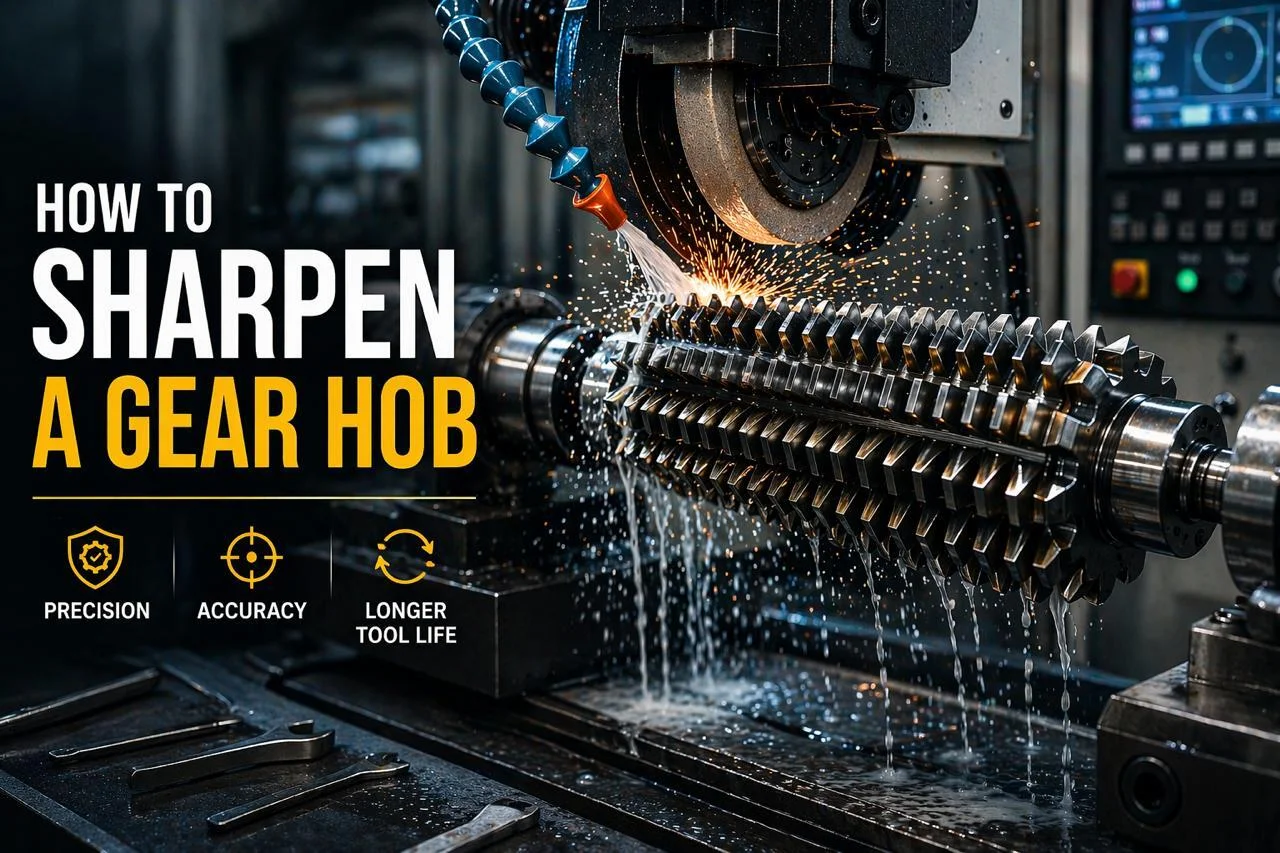
The grinding wheel traverses along the flute helix while the hob rotates. On a properly set up CNC hob sharpening machine, this is automatic — but the operator still needs to verify that the wheel is tracking the full flute width and reaching both ends of the hob body without interference.
What to watch:
- The spark pattern should be consistent across the full length of each flute.
- If you see heavier sparks at one end, the hob axis is not aligned — stop and re-indicate.
- Remove only as much material as necessary to clear the wear land. The less you remove, the more regrinds you get from the hob.
Typical material removal per sharpening: 0.10 to 0.20 mm on the face. Some high-production shops push this down to 0.08 mm when using a high-quality CNC sharpening machine with good process control.
4. Post-Sharpening Inspection and Verification
A sharpened hob that hasn’t been inspected is not ready to run. Post-sharpening checks should include:
Dimensional checks:
- Outside diameter (all rows, at multiple axial positions)
- Runout of cutting edges — typically ≤ 0.010 mm for Class A hobs, ≤ 0.020 mm for Class B
- Lead of flute — verify with a gear measuring machine or dedicated hob tester
Profile and accuracy checks:
- Tooth profile inspection on a gear measuring center (Zeiss, Klingelnberg, Gleason, etc.)
- For critical aerospace or automotive gears, a first-article inspection on a test gear blank after regrinding is standard practice
- Check for grinding burn using Barkhausen noise testing or nital etch on HSS hobs — heat damage from a bad grind is invisible to the eye but catastrophic for tool life.
Hob Regrinding Tolerances: What Standards Say
Gear hob accuracy is classified under DIN 3968 (widely used in Europe and Asia) and AGMA 2002 / ISO 4468 standards. These define the allowable tolerances for:
| Parameter | Class AA | Class A | Class B | Class C |
| Profile error (µm) | ±3 | ±5 | ±8 | ±12 |
| Pitch error (µm) | ±3 | ±5 | ±8 | ±12 |
| Runout (µm) | ±8 | ±10 | ±16 | ±25 |
| Lead error (µm/25mm) | ±4 | ±6 | ±10 | ±16 |
After regrinding, the hob must still meet its original accuracy class. This may sound obvious, but it is frequently overlooked in shops that outsource to a general-purpose tool grinding service rather than a specialist.
A regrinding shop that cannot provide a documented inspection report to these tolerances should not touch your Class A or Class AA hobs.
Now that you understand gear hobbing, take the next step: find the perfect gear hob for your production needs.
How Many Times Can a Gear Hob Be Resharpened?
This is one of the most common questions from purchase managers and tooling engineers trying to calculate cost-per-gear.
The answer depends on:
1. Original hob size and stock allowance
Larger module hobs (Module 6 and above) have deeper, wider flutes and more available regrind stock. A large HSS hob may have 15–25 regrinds available. Afine-pitchhob(Module 1or1.5)mayhaveonly8–12.
2. Material removal per grind
Disciplined sharpening that removes only what is needed (0.08–0.12 mm) dramatically
extends hob life. Aggressive regrinding (0.25 mm+ per cycle) is wasteful.
3. Hob class requirement
Each regrind removes material and slightly changes the outside diameter. As the hob wears down, maintaining the original accuracy class becomes harder. Most shops establish a minimum outside diameter threshold — once a hob reaches this limit, it is retired from precision work even if material remains.
4. Substrate and coating
Uncoated HSS hobs are fully refundable with no additional cost. TiN or TiAlN coated hobs lose their coating on the rake face with every grind — the coating on the relief remains, but the rake face becomes uncoated. For high-speed hobbing applications, re-coating after regrinding (TiN, TiAlN, or AlCrN PVD coating) is strongly recommended to restore original Performance.
Rule of thumb for planning:
Budget for approximately 10–15 regrinds for a standard Module 2–4 HSS hob. Multiply by your average cost-per-regrind, add the re-coating cost if applicable, and compare against the cost of a new hob. Most operations find that a properly managed regrind program cuts tooling cost by 40–60% per hob over its lifetime.
Maintaining Involute Accuracy Through Multiple Regrinds
This is the heart of what separates good hob management from poor hob management. Here’s what degrades involute accuracy across regrinds — and how to prevent it:
Problem 1: Hollow Grind on the Rake Face
Caused by a worn or improperly dressed grinding wheel. A hollow face shifts the cutting edge inward, effectively changing the working pressure angle. The gear still looks acceptable on a surface inspection but fails on a CMM profile check.
Prevention: Dress the grinding wheel before every hob — not every few hobs, every hob.
Problem 2: Incorrect Axial Rake Angle
If the machine is set up with the wrong rake angle (even ½° off), the hob will cut with a modified effective pressure angle. This is compounding — each regrind at the wrong angle moves you further from spec.
Prevention: Verify rake angle setup against the hob’s original specification drawing before each grind. Keep hob drawings on file.
Problem 3: Flute Lead Error
The flute lead (helix angle of the flute) must match the original hob specification. On a manual or semi-automatic machine, this is a gearing setup and can drift. On a modern CNC hob sharpening machine, this is controlled by the machine’s interpolation — but the input must still be verified.
Prevention: Measure flute lead post-grind, not just OD and runout.
Problem 4: Inconsistent Stock Removal Across Flutes
Worn machine centers, poor hob arbor condition, or a bent hob blank cause uneven grinding across flutes. Some flutes get ground correctly; others barely get touched. The result is pitch variation on the finished gear.
Prevention: Check hob arbor condition and machine center condition regularly. Re-indicate hob runout before accepting the setup.
Choosing the Right CNC Hob Sharpening Machine
If you’re evaluating whether to bring hob sharpening in-house, here’s what to look for in a CNC hob sharpening machine:
CNC axes: Minimum 4-axis control (X, Z, A rotation, C indexing). 5-axis machines offer better flexibility for helical hobs and non-standard geometries.
Flute indexing: Electronic synchronization between the C-axis and grinding traverse is essential. Mechanical differential systems are outdated and introduce cumulative errors.
Measurement integration: Some modern sharpening machines integrate a probing or measurement cycle to verify lead and runout after grinding, within the machine. This shortens the feedback loop considerably.
Wheel dressing capability: On-machine diamond roll dressing or point diamond dressing keeps the wheel in condition throughout the cycle.
Common machine brands used in the industry include Vollmer, Star Cutter, Reishauer, and Walter — each with different specializations across hob size ranges. If you’re grinding hobs above Module 10, verify the machine’s capacity for flute depth and hob OD.
For most gear manufacturers, the breakeven point for in-house hob sharpening vs. outsourcing is approximately 80–120 hob regrinds per year. Below that threshold, a qualified External registering service is usually more cost-effective.
Common Hob Sharpening Mistakes (And What They Cost You)
| Mistake | Consequence | Cost Impact |
| Grinding without inspecting for cracks first | Hob breaks in machine, potential spindle damage | Very high |
| Wrong rake angle setup | Profile errors on gear, batch rejection | High |
| Insufficient coolant on HSS hob | Grinding burn, reduced hardness, poor tool life | Medium-hig |
| No post-grind inspection | Running out-of-spec hob on production parts | High |
| Over-grinding (removing too much per cycle) | Premature hob retirement, wasted regrind life | Medium |
| Not re-coating after grinding coated hobs | 30–40% reduction in tool life per regrind | Medium |
Frequently Asked Questions
1. What is the correct way to sharpen a gear hob?
Gear hobs are sharpened by grinding the rake (flute) face — not the outside diameter or flank surfaces. The grinding wheel must follow the helix angle of the flute precisely, removing only the minimum material needed to restore a sharp cutting edge while maintaining the original rake angle and face flatness.
2. How do you maintain involute accuracy when regrinding a gear hob?
Involute accuracy is maintained by holding the correct axial rake angle, using a properly dressed grinding wheel to avoid hollow grind, verifying flute lead post-sharpening, and inspecting the reground hob to its original accuracy class (DIN 3968 or AGMA 2002) before returning it to production.
3. What are the standard tolerances for hob regrinding?
Under DIN 3968, Class A hobs must maintain profile and pitch errors within ±5 µm, runout within ±10 µm, and lead error within ±6 µm per 25 mm. Class AA tolerances are tighter. A regrinding operation that cannot verify these tolerances with a documented inspection report is not suitable for precision gear hobs.
4. How many times can a gear hob be sharpened?
A standard HSS gear hob can typically be resharpened 10–20 times depending on module, flute depth, and material removal per grind. Fine-pitch hobs (Module 1–1.5) have fewer available regrinds than large-module hobs. Each operation should be logged to track remaining regrind life.
5. Should I re-coat a gear hob after regrinding?
Yes, for coated hobs used in high-speed or dry hobbing applications. Regrinding removes the PVD coating from the rake face. Applying a fresh TiAlN or AlCrN coating after regrinding restores the thermal barrier and hardness at the cutting edge, recovering a significant portion of tool life.
6. What is a CNC hob sharpening machine?
A CNC hob sharpening machine is a multi-axis CNC grinding machine specifically designed to regrind gear hob cutters. It synchronizes flute indexing, grinding wheel traverse, and hob rotation to follow the flute helix precisely. Modern machines include on-machine measurement and automatic wheel dressing. Brands include Vollmer, Star Cutter, and Walter.