
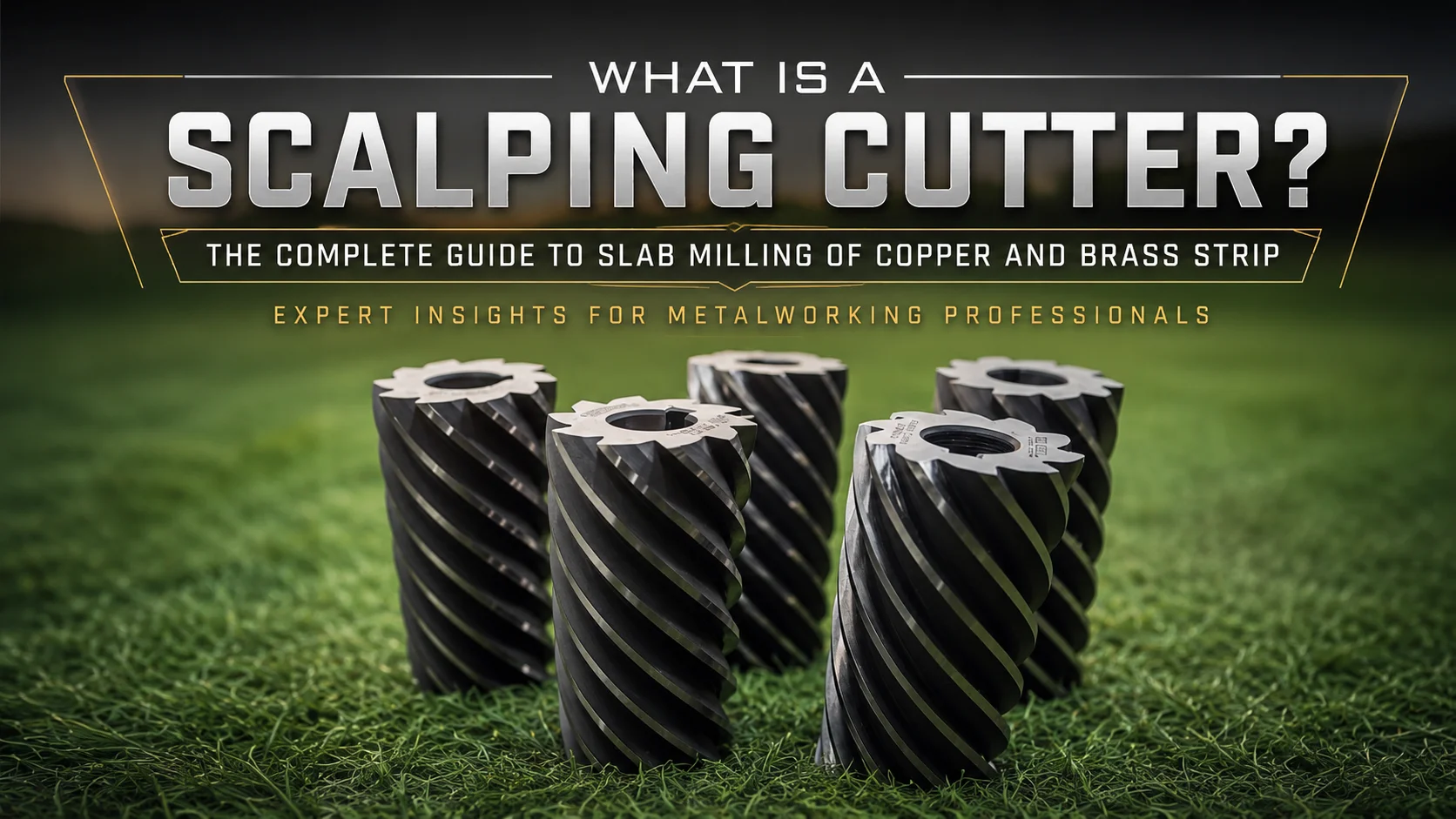
Every coil of high quality copper or brass strip passes through a step most people outside the mill never see: scalping. Before the metal can be cold rolled to the final gauge, a thin, defect-laden layer has to be milled away from its surface. The tool that does this, quietly and at a high stock removal rate, is the scalping cutter. Get it right and the finished strip is clean, flat and consistent. Get it wrong and every downstream operation inherits the damage. This guide explains what a scalping cutter is, why copper and brass producers depend on it, how the cutter is built, and how to choose the right one for your line.
What is a scalping cutter?
A scalping cutter is a large cylindrical milling cutter used to shave a controlled layer of metal off the broad face of a cast or hot rolled semi finished product. It is mounted on a horizontal arbor or a milling head, and the cutting teeth sit on its periphery, running parallel to the axis of rotation. As the workpiece feeds beneath the rotating cutter, those peripheral teeth remove the surface across the full width.
You will hear the same tool called several things. In the machining world it is a slab milling cutter or plain milling cutter, and the operation is plain, surface or slab milling. In a copper or brass mill it is simply the scalping cutter, and the operation is scalping or strip milling. The names describe the same idea: peripheral milling of a wide flat surface for stock removal rather than for fine detail. It is distinct from a face mill, which cuts with teeth on its end face, and from an end mill, which is made for slots and profiles.
Read more: Types of Milling Cutters Used in CNC Machining
What is scalping, and why do copper and brass mills need it?
Scalping is the controlled removal of the outermost layer of a metal product to expose clean, sound material underneath. That surface layer is exactly where casting and hot rolling concentrate their worst problems:
- Oxide and scale: When copper and brass are cast and then hot rolled, the hot surface reacts with the atmosphere and forms an oxide film and scale across every face and edge.
- A damaged subsurface: Prolonged exposure at high temperature lets oxygen diffuse below the surface and lets certain alloying elements evaporate or segregate, leaving a thin skin that is chemically and structurally different from the bulk metal.
- Cast and rolled in defects: Inclusions, porosity, segregation and fine surface cracks all tend to concentrate in the outer layer.
If that layer is rolled into the strip instead of being removed, the defects do not disappear. They get elongated and pressed into the surface, where pickling cannot reliably remove them, and they surface on the finished strip as blemishes, laminations or brittle patches. Scalping removes the problem at its source. Milling the surface away before cold rolling does three jobs at once: it strips the oxide film from both faces and the edges, it equalises the strip’s thickness and corrects its crown, and it presents a clean, uniform surface for the reductions that follow.
Where scalping fits in the copper and brass production flow
In a typical flat rolled copper or brass mill, metal is continuously cast into a cake or slab, then hot rolled to break down the cast structure. The hot rolled slab or strip is then scalped, milling a thin layer off each face, before it moves on to cold rolling, annealing, pickling, slitting and finishing. Some mills that horizontally cast strip directly also mill the cast strip surface before cold rolling. Either way, scalping is the gatekeeper between the hot, dirty end of the process and the precision cold rolling that gives the strip its final properties.
What happens if you under scalp, or skip it
Set the milling depth too shallow and residual oxide and subsurface defects survive into the finished product. Set it too deep and you throw away good metal, cut yield and shorten cutter life for no benefit. The entire value of scalping lies in precise, repeatable depth control: taking off just enough to reveal sound metal and no more. That is why mills invest in rigid, vibration free milling lines, and, just as importantly, in cutters that hold their geometry pass after pass.
How a scalping cutter works
Cylindrical body, peripheral teeth, straight or helical
The heart of the tool is a cylindrical body carrying rows of cutting teeth around its circumference. Those teeth can be straight, parallel to the axis, or helical, wrapped around the body at an angle.
- Straight teeth give an orthogonal cut: every tooth engages the full width at once. Simple to make, but the sudden engagement means higher shock and vibration.
- Helical teeth give an oblique cut: the tooth enters gradually at one end and rolls across the width, so cutting force builds and releases smoothly. That smoother engagement is why almost all serious scalping cutters are helical: it lowers vibration and dynamic load on both the cutter and the machine, protects the cutting edges and gives a better milled finish. The trade off is an axial thrust along the arbor that the machine has to be built to absorb.
Helix angle, tooth pitch and rake
A few geometric choices decide how the cutter behaves:
- Helix angle: Higher helix angles, up to around 45 degrees on heavy duty cutters, reduce cutting forces and improve finish, at the cost of more axial thrust.
- Tooth pitch: Coarse, widely spaced teeth clear big chips and suit high stock removal on soft metals like copper and brass; finer pitches give smoother finishes on harder materials. Heavy duty scalping favours a coarse pitch with generous chip gullets so the soft, gummy copper and brass chips have somewhere to go.
- Rake angle: A positive rake shears soft non ferrous metals cleanly and keeps cutting forces down.
- Chip splitting tooth forms: Serrated or nicked tooth forms break the chip into smaller pieces, which lowers cutting force, reduces chatter and lets the cutter take a deeper, more aggressive cut.
Why cutter length and diameter matter
Because scalping mills the full width of the product in one pass, the cutter has to be at least as long as the strip or cake is wide. Copper and brass cakes and wide strip can be very wide indeed, which is why scalping cutters are among the longest milling cutters made. The largest run to well over a metre in overall length; Maxwell manufactures them up to 1600 mm, which is beyond what most tool makers can grind. Diameter matters too: a larger diameter puts more teeth in the cut and runs more smoothly, but demands more spindle power. Chip evacuation and rigidity become the limiting factors as size grows, so a well designed scalping cutter is a careful balance of length, diameter, tooth pitch and gullet space.
What are scalping cutters made from?
The right cutting material depends on the alloy being scalped, the depth of cut, the volumes, and whether you want to resharpen or index.
High speed steel and powder metallurgy HSS
Conventional HSS grades such as M2, a general purpose tungsten molybdenum grade, and M35, a cobalt bearing grade with extra hot hardness, are the workhorses of copper and brass scalping. They are tough, they take a keen positive edge that suits soft non ferrous metal, and, crucially, they can be regrown many times over the life of the cutter. Powder metallurgy HSS such as ASP 2030 raises the game further: its very fine, evenly distributed carbides give a tougher, more wear resistant edge that holds up to heavier and interrupted cuts while remaining resharpenable. For most copper and brass strip and cake scalping, an HSS or PM HSS cutter, properly hardened, with vacuum hardening to keep the geometry stable, and coated, is the sweet spot of performance and cost.
Indexable carbide inserts
For high volume lines, or for more abrasive materials, cutters fitted with indexable carbide inserts change the economics. Instead of pulling the cutter for regrinding, the operator simply rotates or swaps a worn insert, so the cutter body lasts for years and downtime is minimal. Carbide’s wear resistance also lets the line run faster. The trade offs are a higher initial cost and less of the clean, keen edge that HSS gives on soft metals, so inserted cutters make most sense where throughput and uptime dominate.
Read more: Types of Carbide Cutting Tools and Their Uses
Coatings
A hard, low friction coating such as TiN or TiAlN extends edge life, reduces the tendency of soft copper and brass to stick and build up on the edge, and helps chips flow. A coating is not a fix for the wrong substrate or geometry, but on the right cutter it adds meaningful life.
How to choose the right scalping cutter
No two lines are identical, and the best cutter for a given mill depends on the answers to a handful of questions. Use this as a starting checklist when you specify a cutter or brief a supplier:
| Factor | What to consider |
| Metal being scalped | Copper, brass, bronze, cupronickel, nickel silver or aluminium. Alloy hardness and gumminess drive edge material, rake and tooth pitch. |
| Product width | The cutter length (overall length) must cover the full strip or cake width so the surface is scalped in a single pass. |
| Diameter and bore | Diameter sets how many teeth are in the cut and the spindle power required; the bore must match your arbor exactly for a true, secure fit. |
| Depth of cut per face | Governs how aggressive the geometry and pitch should be. Typically a fraction of a millimetre up to a few millimetres per side, often around 0.2 to 0.5 mm on strip lines. |
| Machine | A horizontal or universal milling machine, or a dedicated milling / scalping line. Rigidity and available power decide what the cutter can do. |
| Roughing vs finishing | Coarse, chip splitting teeth for heavy stock removal; a finer pitch where surface finish is the priority. |
| Cutting material | HSS (M2, M35) or PM HSS (ASP 2030) for a resharpenable, keen edged tool; indexable carbide for high volume, high uptime lines. |
| Coating | TiN or TiAlN to extend edge life and control the built up edge that soft copper and brass tend to form. |
| Regrind vs index | Whether you would rather resharpen a solid HSS cutter or simply rotate and replace carbide inserts. |
Because these variables interact, most serious scalping cutters are made to order. Specifying the exact diameter, length, bore, tooth form and material for your line matters far more here than buying a stock part. It is worth comparing notes with a specialist milling cutter manufacturer before you commit to a geometry.
Maintenance, regrinding and getting the most cutter life
A scalping cutter is a precision tool, and its life depends on how it is looked after:
- Resharpen before the edge is badly worn: Regrinding a lightly dulled HSS or PM HSS cutter removes far less material, and gives many more cycles, than letting it wear until it tears the surface.
- Keep runout and balance in check: A long cutter running out of true chatters, wears unevenly and marks the strip. Balance and concentric mounting are as important as the edge itself.
- Mind the bore and arbor fit: A worn or loose bore lets the cutter shift under load, ruining finish and accelerating wear. Bores are precision ground for a reason.
- Inspect the geometry: Checking key dimensions on a coordinate measuring machine after grinding keeps the cutter within tolerance, so every regrind performs like the first.
- Index inserts on schedule: On inserted cutters, rotating inserts at the right point keeps cutting forces and finish consistent and protects the body.
Read more: How to Sharpen a Gear Hob: Best Practices for Maintaining Involute Accuracy
Scalping cutters for aluminium and other metals
Copper and brass are the classic scalping applications, but the same principle applies wherever a cast or hot worked surface has to be cleaned up before further processing. Aluminium rolling slabs and extrusion billets are scalped or peeled to remove the cast skin, and specialty metals are scalped to remove defects before demanding downstream steps. The cutter geometry and material change with the metal: aluminium, for example, prefers very high helix angles, polished flutes and large chip gullets to keep its soft, sticky chips flowing. The underlying job, revealing sound metal beneath a defective surface, stays the same.
Read more: Best End Milling Cutters for Steel & Aluminum: A Practical Buyer’s Guide
Frequently asked questions
What is a scalping cutter used for?
It is used to mill a thin, controlled layer off the surface of a cast or hot rolled metal product, most often copper and brass strip, slabs and cakes, in order to remove oxide, scale and subsurface defects before cold rolling.
Is a scalping cutter the same as a slab milling cutter?
Essentially yes. Slab milling cutter, or plain milling cutter, is the machining term for the tool; scalping cutter is what the same tool is called when its job is to scalp the surface of copper, brass or other metal semis. Both cut with teeth on the periphery of a cylindrical body.
What is scalping in metalworking?
Scalping is the controlled removal of the outer layer of a metal product to expose clean, defect free material underneath. It is a mechanical complement to chemical pickling, and it also equalises thickness and corrects the surface profile.
Why are copper and brass strips scalped after hot rolling?
Hot rolling leaves an oxide film, scale and a defect rich subsurface layer. If that layer is cold rolled into the strip it becomes permanent surface damage that pickling cannot fix. Scalping removes it first, giving a clean, uniform surface and consistent thickness.
What are scalping cutters made of?
Most are high speed steel (M2, M35) or powder metallurgy HSS such as ASP 2030, which can be resharpened, or they are fitted with indexable carbide inserts for high volume lines. Hard coatings such as TiN or TiAlN are often added.
How deep is a scalping cut?
It depends on the product and how deep the defect layer runs, but it is typically small: from a fraction of a millimetre up to a few millimetres per face, and often around 0.2 to 0.5 mm per side on copper and brass strip lines.
Can scalping cutters be resharpened?
HSS and PM HSS scalping cutters can be reground many times, which is a large part of their value. Cutters with carbide inserts are not reground; worn inserts are rotated or replaced instead.
What sizes of scalping cutter are available?
Diameters and bores are matched to the machine, and length is matched to the product width. Because copper and brass cakes and strip can be very wide, scalping cutters are among the longest milling cutters made; Maxwell produces them up to 1600 mm overall length.
Talk to a scalping cutter specialist
Maxwell Tools has manufactured scalping and cylindrical milling cutters for the world’s copper, brass and non ferrous strip and sheet producers for decades, including sizes up to 1600 mm overall length that few others can make. Every cutter is built to the exact diameter, length, bore, tooth form and material a given line needs, in HSS, PM HSS or with carbide inserts. If you are specifying a scalping cutter, or want to improve surface quality, yield and cutter life on your milling line, see our cylindrical / scalping cutters or contact us for a made to measure recommendation.