
You’re running a tight slit pattern — five or six strips off a CR coil — and everything looks fine until the strips come off the recoiler. One strip is slightly wider than spec. Another has surface marks that are going to get rejected by the customer. The knife setup looked correct. The clearances were set properly. So what went wrong?
Nine times out of ten, the answer is sitting right there on the arbor, sandwiched between the knives: the spacers.
Specifically, rubber bonded spacers that are worn down, hardened from age, or simply the wrong type for the material being run. It sounds like a small thing. It’s not.
What Are Rubber Bonded Spacers?
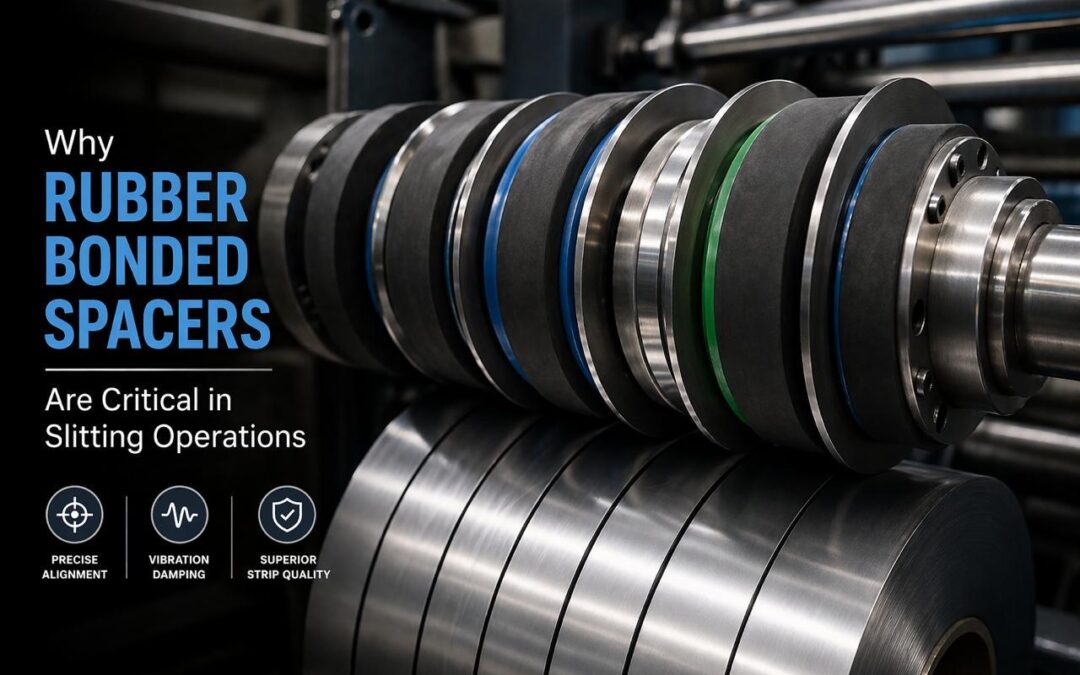
Rubber bonded spacers are precision-manufactured components used on the slitter arbor alongside rotary slitter knives. They consist of a hardened steel core — typically EN31 or EN8 alloy tool steel — with a synthetic rubber layer vulcanized directly onto the outer surface.
That rubber layer is load-bearing in ways most operators don’t think about. It contacts the coil strip as it travels through the knife assembly, stripping the material off the blades, absorbing vibration, and maintaining consistent lateral pressure on the strip.
The steel core gives the spacer its dimensional accuracy. Maxwell rubber bonded spacers are manufactured to a thickness tolerance of ±0.001 mm, which is the level of precision the arbor setup actually demands. The rubber gives it the controlled flexibility that pure metal spacers cannot.
The Alignment Problem That Silent Spacers Cause
Here is something worth understanding about how slitting geometry actually works. The knife clearance you set is not just a gap between two blade edges. It’s a three-dimensional relationship that depends on every component on that arbor staying exactly where you put it.
When rubber spacers wear unevenly or compress under load without recovery, the knives drift laterally during the cut. This happens in fractions of a millimeter — amounts you will never see by eye — but the strip width and edge quality will show it immediately.
Worn rubber spacers also allow the knife to rock very slightly under the cutting force, which changes the effective clearance at the moment of shear. You’ll see this as inconsistent burr height across a batch, or as one edge of the strip looking clean while the opposite edge shows a ragged fracture zone.
The function of the rubber layer here is not cushioning in a passive sense. It maintains radial contact pressure on the strip while allowing the strip to release cleanly from the blade face after the cut. That release function is what prevents the strip from being dragged sideways rather than advancing forward, and dragged strips are the number one cause of width deviation that isn’t explained by knife setup errors.
Vibration Damping: The Function Nobody Budgets For
Steel slitting lines run at speeds where mechanical resonance becomes a real operating problem. At high line speeds, the rotating arbor assembly generates harmonic vibration that amplifies through the knife stack. If every component in that stack is rigid metal, the vibration has nowhere to go and it gets transmitted directly into the cutting zone.
The result is a phenomenon most operators know as chatter marks — a periodic wave pattern on the strip edge or surface that corresponds exactly to the resonant frequency of the arbor assembly.
Rubber bonded spacers are one of the few components in the tooling stack that actively damp this vibration rather than transmitting it. The rubber compound absorbs and dissipates the harmonic energy before it reaches the knife edge contact point. This is not incidental to the design. It’s one of the core reasons rubber bonded spacers exist as a category distinct from plain metal spacers.
If you’ve ever run the same knife setup on the same material at two different line speeds and noticed edge quality degrade as speed increases, vibration transmission through worn or over-hardened spacers is likely involved.
Nitrile vs Polyurethane: Choosing the Right Rubber for Your Application
Not all rubber bonded spacers use the same rubber compound, and the difference matters depending on what you’re running.
Nitrile rubber (NBR) is the standard choice for most steel slitting applications. It has excellent oil resistance, which matters because the strip surface and arbor components are typically oiled or coated with mill lubricants. NBR maintains its physical properties well in these conditions and has a hardness range of approximately 70 to 85 Shore A for most slitting applications. It handles normal line speeds and standard carbon steel, CRCA, and galvanized strip without issue.
Polyurethane (PU) is the right choice when you need higher hardness, better abrasion resistance, or when you’re running harder materials like stainless steel or high-tensile strips that put more lateral force on the spacer face. PU spacers can hold tighter contact pressure over a longer service life when the cutting forces are high. They’re also better suited for high-speed lines where NBR starts to generate heat from friction.
Maxwell manufactures rubber bonded spacers in both NBR and PU compounds, color-coded by outer diameter to differentiate male and female sets during setup. That color coding matters more than it sounds when an operator is assembling a multi-cut arbor under time pressure.
Why Surface Marking Traces Back to Spacers
If your strips are showing light surface scratches or score lines that aren’t coming from the knife edge, the most likely source is the rubber spacer surface condition.
A spacer that has lost its rubber layer even partially, or one that has a hardened, glazed rubber surface from running at high temperatures, becomes an abrasive contact rather than a yielding one. It now slides against the strip surface instead of releasing cleanly. On bright-finish cold-rolled material, galvanized, or any coated strip, this shows immediately as surface defects that are cosmetically unacceptable.
The fix is not to adjust the knife setup. It’s to replace the spacers.
This is one of the most common misdiagnoses in slitting operations. The operator sees inconsistent width or surface marks, assumes it’s a knife clearance issue, resets the arbor, runs another coil, and gets the same result. The knives were fine the whole time.
How Long Should Rubber Bonded Spacers Last?
There’s no universal answer because service life depends heavily on line speed, strip material, cutting forces, and how often the arbor is disassembled and reassembled. That last factor — handling — causes more rubber spacer damage than running does.
Rubber bonded spacers should be stored flat, kept away from oil contamination between uses, and never used as leverage points when assembling or disassembling the arbor. The rubber layer can separate from the steel core if the bond line is stressed repeatedly.
As a working guideline: if a spacer shows visible rubber compression that doesn’t recover when unloaded, surface glazing, cracking at the rubber-to-steel interface, or dimensional variation beyond ±0.003 mm when checked with a micrometer, it needs to be replaced.
Running degraded spacers is not a minor economy. The cost of a strip width rejection or a customer complaint about surface finish on a full coil order is orders of magnitude higher than the cost of a spacer.
What to Look for in Rubber Bonded Spacers
When you’re sourcing rubber bonded spacers, these are the specifications that actually determine whether they perform on your line:
Thickness tolerance: The tighter, the better. ±0.001 mm is the standard for precision slitting applications. Spacers with looser tolerances introduce cumulative error across the knife stack that shows up as width drift.
Steel core material: EN31 is the correct choice for most applications. It achieves the hardness needed to resist deformation under cutting loads while maintaining dimensional stability. EN8 is suitable for lighter-duty applications.
Rubber bond integrity: The rubber should be vulcanized to the steel core, not adhered. Vulcanized bonds survive the thermal cycling and mechanical loading of slitting operations. Adhesive bonds eventually fail.
Hardness specification: For most CR and HR steel slitting, a rubber hardness of 75 to 85 Shore A is the practical range. Harder is not always better — too hard and the spacer loses its vibration damping and strip release functions.
Color coding: Male and female spacer sets should be visually distinguishable. Setup errors on complex arbor configurations are reduced significantly when the operator can distinguish component sets at a glance.
Frequently Asked Questions
What is the difference between rubber bonded spacers and metal spacers on a slitting line?
Metal spacers set the lateral distance between slitter knives and are rigid. Rubber bonded spacers serve a different function: they contact the strip surface, strip the material away from the knife face after the cut, damp vibration in the rotating assembly, and protect the strip surface from scratching. Most slitting lines use both types together.
Can I use the same rubber bonded spacers for stainless steel and carbon steel slitting?
For stainless steel or high-tensile materials, polyurethane rubber spacers are generally preferred over nitrile because they handle higher contact forces and generate less heat. Using standard NBR spacers on stainless at high speeds will shorten spacer life and can affect strip surface quality.
How do I know when rubber bonded spacers need to be replaced?
Check for rubber compression that doesn’t spring back when unloaded, surface glazing or cracking visible on the rubber face, dimensional drift beyond ±0.003 mm, and any separation at the rubber-to-steel bond line. Unexplained strip width variation and surface marking on the strip are strong indicators.
What Shore hardness should rubber bonded spacers be for steel slitting?
For standard steel slitting applications (CRCA, HR, GI, PPGI), a hardness of 75 to 85 Shore A is appropriate. For high-speed lines or hard alloy materials, spacers in the 85 to 90 Shore A range of polyurethane compounds are more suitable.
Why do rubber bonded spacers have color coding?
Male and female spacer sets have different outer diameters. Color coding allows operators to identify the correct set during arbor assembly without measuring every piece, reducing setup errors on multi-cut configurations and speeding up changeover.
Do rubber bonded spacers affect knife clearance?
Not directly, but worn spacers affect knife stability during the cut, which changes the effective clearance at the moment of shear. This is why spacer condition is part of a complete arbor audit whenever edge quality problems appear.
The Right Spacers Make Everything Else Work
The slitter knife gets all the attention when edge quality problems appear on the line. The spacer does the work in silence until it stops working, and by then you’ve already run coils that are coming back as rejections.
Maxwelltools has been manufacturing rubber bonded spacers since 1975, supplying steel service centers, coil processing lines, and slitting operations across India and internationally. Our spacers are manufactured with hardened EN31 and EN8 steel cores, available in nitrile and polyurethane rubber compounds, and held to ±0.001 mm thickness tolerance throughout.
If you’re looking to reduce strip width variation, eliminate surface marking issues, or simply want spacers that last longer between replacements, we’re here to help.
View our rubber bonded spacers and get a quote: https://www.maxwellslitters.com/rubber-bonded-spacers/